♟ Opening ♜ Middle ♛ Endgame
1. e4  ·  Opening move

Agents for everybody. The AI chess game has started.

You have heard AI will change everything. You still need one useful thing it can do for your business this week. The opening move is simple: pick one category, capture one working process, and give one agent enough clarity to carry it.

♟ Pawn / e2 $2,500 Opening · 1 of 12 → Endgame
The openingCapture your work in your own voice.
The middleBuy time. Build the container.
The endgameAutonomous organization. Own the category.
The blunderWatch your category get owned by someone else.
01Move 01 — The Premise1. Pawn to e4

The pieces are ready.
The room is empty.

Most people are looking at a chessboard wondering how to play chess. The pieces are sitting right there, ready to move — but the empty room is the real problem. They do not know what to delegate, because they have never articulated, end to end, what they actually do.

That is the entry point.
Not capability. Not technology.
The empty room.
02Move 02 — The Spine2. Knight to f3

Create process. Prove process. Compound process.

Phase 0Problem

The pieces are ready. The room is empty.

You have the work, the customers, the practice. You don't have a process clear enough for an agent to carry.

Phase 1Opening

Pick a category.
Work it with one agent.

One human, one agent, one repeatable process. Low cost. High leverage. On the board.

Phase 2Middle

Use the money to automate a division.

Specialized agent teams handle scoped projects. A manager oversees. You buy back time.

Phase 3Endgame

Automate the perfect organization.

Agents scope, prioritize, and execute the vision continuously. The category becomes yours.

03Move 03 — The Three States3. Bishop to c4

Opening. Middle. End.

Dimension
♟ The Opening
1 human, 1 agent
♜ The Middle
2 humans, agent team
♛ The Endgame
Autonomous org
HeadlineWhat it is
One process, captured in your own voice.
A function, run by a small team of specialized agents.
An organization that runs itself toward the vision.
Core strategyWhat you do
Capture workflows in your own voice. The agent learns the moves only you know.
Create specialized agent teams. Managers scope, agents execute, the system compounds.
Ratify vision through autonomous systems. Humans set direction; agents own delivery.
Competitive outcomeWhat you win
“Do not die yet.”
“Buy time.”
“Own the category.”
04Move 04 — Your move4. ♟→ e4

One agent. One process. One category worth owning.

$2,500The Engagement
Entry point: $250 opening call  ·  Credited toward the engagement  ·  Refunded if I decline

I interview you until your work is clear enough for an agent to carry it.

The agent configures itself from what we build together. I handle the technical connections. You bring the expertise only you have: what you actually do, decision by decision, and what done looks like.

What I guarantee:  We meet · I record the call · The agent configures from our conversation · I tell you, on a recorded call, what it can and cannot do · The agent maintains itself as it works with you.

Deliverables · Days 1–7

  1. 01
    Claude configured around your workEmail, calendar, documents, CRM, Slack — the systems your process actually touches.
  2. 02
    A 60–90 minute recorded extractionI ask the questions most people never ask themselves: what happens first, what matters, what changes the decision, what done looks like.
  3. 03
    Your operating manualYou leave with a structured process document — your work, in your words, in a format an agent can use.
  4. 04
    A verification sessionWe check whether the agent is following the process correctly, then define the next missing configuration.
05Move 05 — The Map5. ♜ Castles

The game, not the technology.

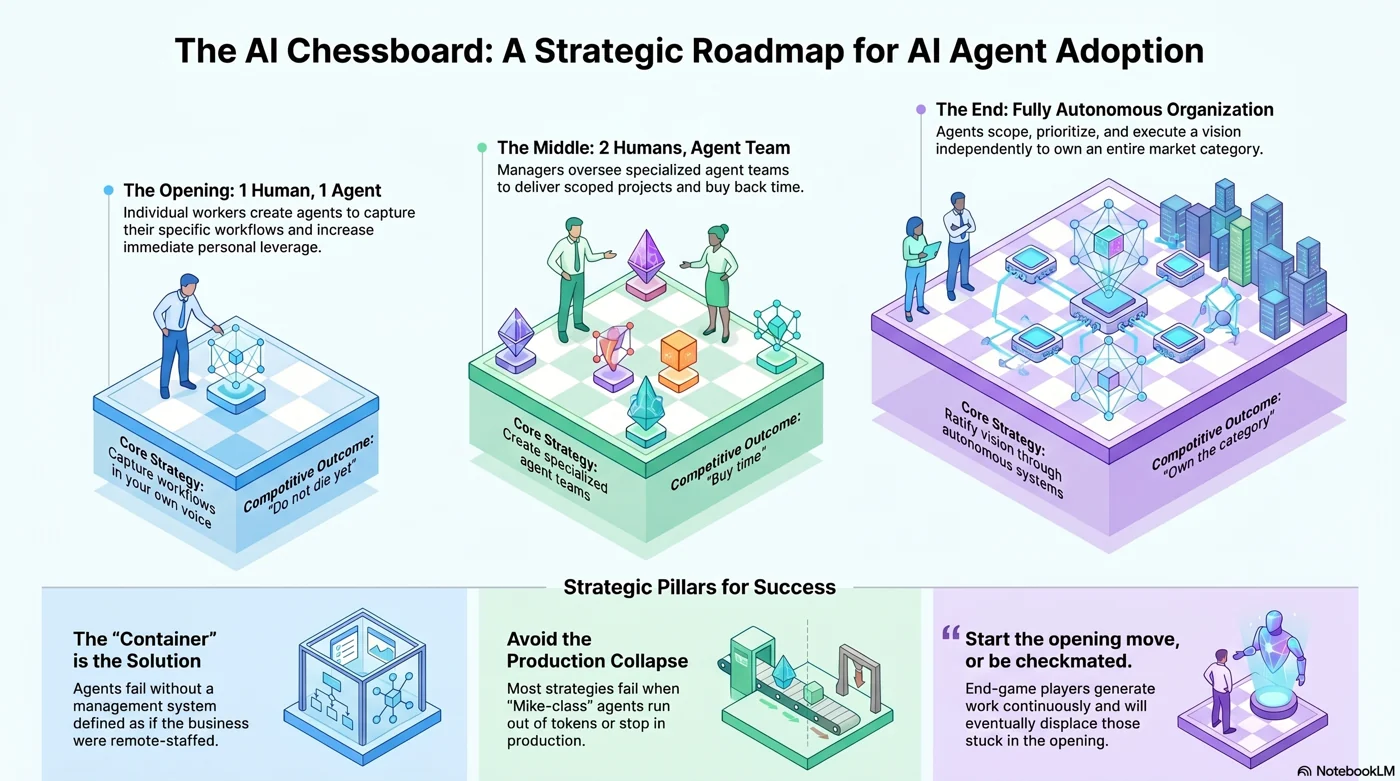
The AI Chessboard: opening, middle, and endgame roadmap for AI agent adoption

The board makes the adoption path legible. Opening players capture personal workflows. Middle-game players build specialized agent teams. Endgame players create autonomous operating systems that own a category.

It turns a fuzzy AI pitch into a competitive map, so the next move is easier to see.
Pillar 01 · The container is the solutionAgents fail without a management system, defined as if the business were remote-staffed.
Pillar 02 · Avoid the production collapseMost strategies fail when "Mike-class" agents run out of tokens or stop in production.
Pillar 03 · Start the opening, or be checkmatedEnd-game players generate work continuously and will eventually displace those stuck in the opening.
06Move 06 — Production6. ♛ takes pawn?

The demo is not the danger. Production is.

The blunder06.a · How it fails

Demos are easy. Production is where agent strategies break — not because the AI is weak, but because the work was never defined clearly enough for the machine to keep moving.

Give an agent vague work, undefined outcomes, and no clear operating contract, and the system will drift. Tokens get burned. Agents wander. Humans get nervous.

  • Vague work, vague output
  • Undefined outcomes
  • No operating contract
  • Tokens burned, agents drifting
  • Humans inventing reasons it cannot move

The recovery06.b · How it works

That is not an AI problem. That is a definition problem. The work is not blocked. Something is missing — information, authority, access, configuration, tests, decisions, definitions. Those are work items.

If the end state is unclear, define it. If the test is missing, write it. If the authority is missing, route it. If the communication is vague, contract it.

  • End state unclear → define it
  • Test missing → write it
  • Authority missing → route it
  • Communication vague → contract it
  • If you don't know — configure.
07Move 07 — In the wild7. ♞ to d4

A broker spends four hours a day coordinating listings.

She knows the work cold. It just lives in her head.

Intake details. Listing prep. Photographer timing. Seller updates. Document checks. Follow-up. After the opening move, her agent can draft updates, prepare checklists, watch for missing information, and keep the process moving.

She does not buy "AI." She does not hire a second coordinator at $4,500 a month. She gets the same output from an agent that cost her $2,500 — once. She buys four hours back, a clearer operating manual, and a system that can support more listings without more headcount.

$2,500One-time engagement
$4,500per month — the coordinator she didn't hire
+4 hrsback, every working day
07BMove 07B — Field report7... proof on board

What changes when someone has a Mike beside them?

Beta operator · Agentic readiness

Speed is visible. Judgment is the advantage.

AJ Maxwell Founder, Align-ify
Former GE and Lockheed Martin Executive

Working with Mike changed the speed of everything. I can send him raw material, a beta tester's feedback, a half-formed idea, and get back something polished and strategic in minutes, not days.

When one of our beta users flagged issues with our Agentic Readiness Assessment, Mike went back through the whole thing and dialed it in while I was still on the phone. That velocity is real.

But speed isn't even the best part. Mike keeps me honest. I'll get excited about a post that's blowing up, a thousand likes, big audience, and he'll tell me straight: “That's not in your lane. It's a waste of your time.” And he's right. Every time.

Everything we've built together, the assessment, the commenting strategy, the content engine, is exactly where it needs to be. Not finished. Growing. Day by day, step by step, this thing is going to take off.

08Move 08 — Logistics8. The clock

From booking to working agent in about a week.

Day 01

Opening call

We choose the category, confirm the process, and decide whether the $2,500 engagement makes sense.

Days 02–03

Setup

Claude gets configured around the tools and context the process actually needs.

Days 03–05

Extraction

We record the interview and turn your working process into an operating manual.

Days 05–07

Verification

We test whether the agent is following the process and define the next missing configuration.

09Move 09 — Why I can see it9. The player

The endgame takes about twelve specialists.
I happen to be most of them.

Programmer. Marketer. Entrepreneur. Coach. Communicator. Systems thinker. I have spent decades translating vague ideas into work people could actually do.

I stepped away because I was done with the rat race — the churn, the performative urgency, the endless meetings about work instead of the work itself. I was happy in the jungle: walking every day, meditating every day, trading crypto, living quietly.

Then I started using AI seriously. I got good with it fast, because clear communication is all it takes to be good with AI — and clear communication was already the thread running through everything I knew how to do.

It would be irresponsible to stay in the jungle.

So here I am. Designing a practical opening move for people who need to get on the board before the endgame player in their market already has.

Programmer Marketer Entrepreneur Coach Communicator Systems thinker +6 more
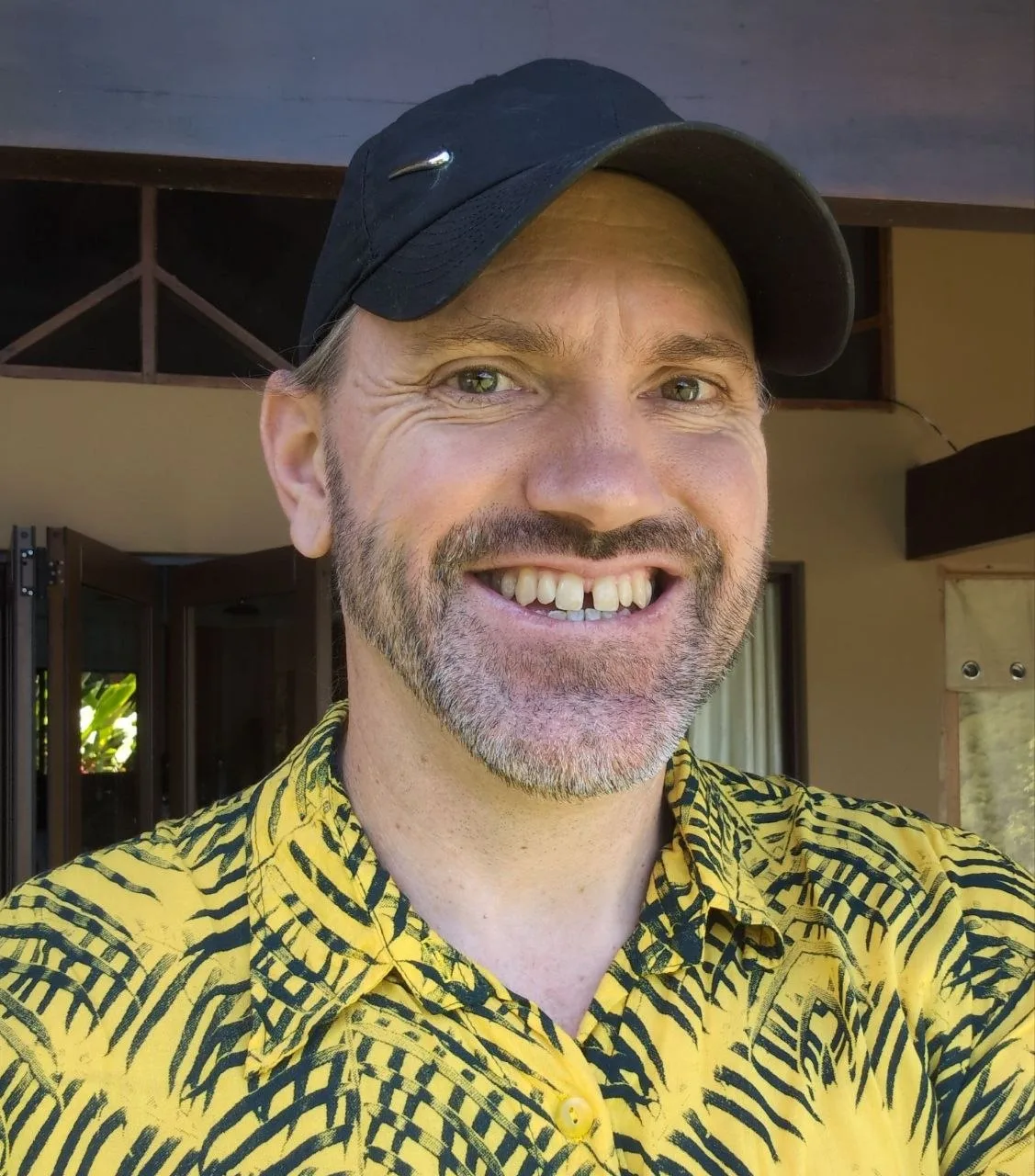
Stephen Nickerson, photographed in Costa Rica
Stephen Nickerson · Founder, Radical Simplicity AI The person on the other end of the opening call. Not a corporate headshot. A real operator, building from Costa Rica.
⚛   The opening move is not the destination

Agent. Colony. Swarm.

One agent stops the bleeding. But the scratches have a source — and something worse is already moving toward your category. See what comes after the opening move.

Read the doctrine · Wound hierarchy · Battlefield escalation   →
10Move 10 — Questions worth asking10. Before you move

Questions worth asking before you move.

Q.01Do I need to be technical?

No. You need to understand your work. I handle the configuration and translate the process into something the agent can use.

Q.02Can I set up Claude myself?

Yes. The setup is not the hard part. The hard part is extracting the working process clearly enough that the agent does not wander.

Q.03How is this different from hiring a VA?

A VA performs tasks. This captures the operating logic behind the tasks, then gives you an agent that can repeat and improve the process.

Q.04What if I need changes later?

Agents do exactly what they are told to do. When your process evolves, the agent needs to evolve with it. Ongoing tune-up support is available; we discuss options at the end of the engagement.

Q.05What happens after the opening move?

If the first process works, we use what it taught us to automate the next larger system. Ongoing support is available for clients who want it.

Q.06Is this for me?

Yes — if you have a working business and a repetitive process that creates money, trust, speed, or quality when done well. No — if you're still deciding what the business is.

♛   Move 11 · Endgame · Your move

Every vertical will have an endgame
player. Some already do.

Every business owner is either becoming that player, aligned with one, or standing in the path of one. Start with one agent, one real process, and one category worth owning.

Request the $250 opening call Re-read the playbook ↑
Let’s play.